
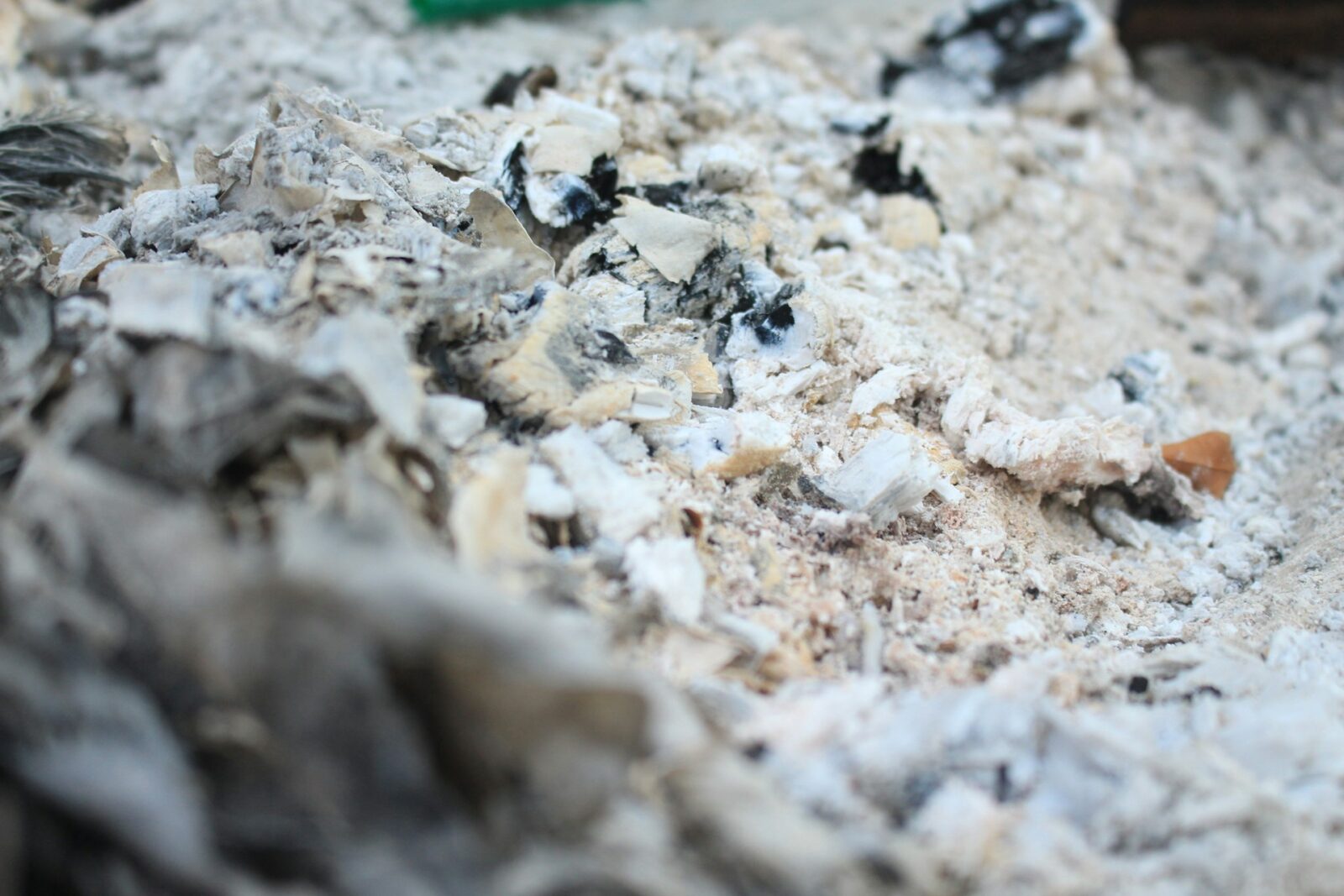
Cremation ashes – also called cremains or cremated remains – are not ash in the fireplace sense. They are processed bone mineral, mostly calcium phosphate in the form of a compound called hydroxyapatite, which makes up roughly 70% of human bone. After cremation, what remains is bone, dried and stripped of all organic matter by intense heat, then refined in a machine called a cremulator into a fine, pale powder. An adult’s cremains typically weigh 2 to 4 kg, fill a volume of about 3.3 litres (200 cubic inches), and are sterile and entirely safe to handle.
When families receive cremation ashes for the first time, the most common reaction is surprise. The container is heavier than they expected. The texture is closer to coarse sand than the soft, soot-like ash of a fireplace. The colour is pale, not dark. None of this matches the word „ashes” as most of us use it in everyday language – and that gap between expectation and reality can be unsettling.
This guide explains, in plain terms, what cremation ashes actually are: what they are made of, why they look the way they do, why they weigh what they weigh, and what is normal and what is not. It is written for British families and complements our wider guide to cremation explained and to how cremation works.
The most important thing to understand
The single biggest misunderstanding about cremation ashes is in the word itself. „Ashes” suggests what is left at the bottom of a fireplace – dark, soft, light, mostly carbon. Cremation ashes are not that at all. They are not the burned-off tissue of the body, and they are not the leftover material of the coffin. Both of those leave the cremator as gas and vapour, drawn through the secondary chamber and filtered before release.
What you receive is the mineral content of the bones, dried and processed into a uniform texture. That distinction changes how the ashes look and feel, how heavy they are, how stable they are over time, and even how safely they can be handled.
Key takeaway: Cremation ashes are processed bone mineral, not ash in the fireplace sense. They are pale, granular, sterile, and remarkably stable. Understanding this single fact makes everything else about the ashes feel less unfamiliar.
What cremation ashes are made of
Bone is built from two main components: an organic framework (mostly the protein collagen, plus water and fat) and an inorganic mineral matrix (mostly calcium phosphate). At cremation temperatures of 800 to 1,000°C, the organic portion is consumed – it leaves the chamber as gas and water vapour. The mineral portion remains.
That mineral portion is dominated by a single compound: hydroxyapatite, a crystalline form of calcium phosphate that gives bone its hardness. Hydroxyapatite makes up around 70% of human bone by weight. After cremation, it is the principal component of what you receive.
Composition by element
Although the exact percentages vary slightly from person to person, the broad composition of cremation ashes by element is well documented. The table below sets out the main constituents.
| Component | Approximate share | Where it comes from |
|---|---|---|
| Phosphate | About 47% | Bone mineral (hydroxyapatite) |
| Calcium | About 25% | Bone mineral (hydroxyapatite) |
| Sulphate | About 11% | Bone matrix and trace deposits |
| Potassium | About 3.7% | Bone and tissue trace minerals |
| Sodium | About 1.1% | Bone and tissue trace minerals |
| Chloride | About 1% | Trace minerals |
| Other trace elements | About 11% | Magnesium, zinc, iron, silica, and others naturally present in bone |
Together, phosphate and calcium account for nearly three-quarters of the total – which is exactly what you would expect from a material that is essentially purified bone mineral.
Did you know? Hydroxyapatite is so chemically stable that fossilised bone from millions of years ago still contains it. The reason cremation ashes can be kept indefinitely without changing is the same reason fossils last: calcium phosphate is one of the most enduring substances in the natural world.
Cremains, ashes, cremated remains – which word is correct?
All three terms refer to the same material, and each has its place.
- Ashes is the everyday word most families use. It is informal, gentle and widely understood.
- Cremated remains is the formal, neutral term. It is the wording used on official paperwork and in legal and regulatory contexts.
- Cremains is a contraction of „cremated remains”, more common in North American usage but increasingly seen in the UK industry.
In British funeral language, „ashes” remains the most common word in conversation, and „cremated remains” the most common in writing. There is no right or wrong choice – they all describe the processed bone mineral you receive after a cremation.
What cremation ashes look and feel like
Because cremains are mineral rather than carbonised tissue, they look and feel quite different from what most people expect.
Colour
The colour of cremation ashes typically ranges from pale grey to off-white. Tan, sandy and very pale ivory tones also appear. Occasionally there may be slightly darker flecks. None of this indicates anything unusual; the variation comes from differences in bone composition, body chemistry and the precise temperature profile of each cremation. Hindu and Sikh traditions sometimes describe the cremains as „white as snow” – a recognition that this is bone, purified by heat.
Texture
The texture is most often described as coarse sand or fine grit, rather than soft powder. There may be small, slightly heavier particles within the mass. This is the result of the cremulator stage of processing, which reduces the larger bone fragments to a uniform consistency without grinding them to dust. Some UK crematoria produce a finer texture than others, depending on equipment and operating preferences.
Smell
Properly processed cremains have no smell. Any organic material that could produce odour has been consumed by the heat of the cremation. If a faint scent is present, it is usually from the temporary container itself, not the ashes.
Weight and volume
For an average adult, the ashes typically weigh between 2 and 4 kg and fill a volume of about 3.3 litres, or 200 cubic inches. This corresponds to roughly 3.5% of the person’s body weight before cremation. The proportion is remarkably consistent, and it is the reason the standard adult urn is sized at 3.3 litres.
| Property | Typical adult range |
|---|---|
| Weight | 2 – 4 kg |
| Volume | About 3.3 litres (200 cubic inches) |
| Proportion of body weight | About 3.5% |
| Colour | Pale grey to off-white |
| Texture | Coarse sand to fine grit |
| Smell | None |
For a step-by-step explanation of how the body becomes these mineral remains, see our companion article on what happens to the body during cremation.
Key takeaway: Cremation ashes are pale, granular, odourless, and heavier than most people expect. The properties make sense once you understand they are bone mineral, not the soft carbon residue of a fire.
Are cremation ashes safe to handle?
Yes. Cremation ashes are entirely sterile and pose no health risk. The heat of the cremation chamber – sustained at 800°C or higher for around two hours – destroys all biological material that could carry infection. There is no bacteria, no virus, no organic decomposition product.
You can handle the ashes with your bare hands without any harm. Most families nevertheless wear gloves when transferring ashes from the temporary container into a chosen urn, simply because the texture is slightly dusty and a little may settle on the skin. A small amount of moisture (a brush of soapy water on the hands afterwards) is all that is needed.
Good to know: Cremation ashes are not classified as hazardous waste in the UK. They are legally regarded as the personal property of the family or the person named on the cremation application form, and may be transported, stored, scattered or buried at the family’s discretion (with the landowner’s permission where relevant).
Common questions about the science of cremains
Is there any DNA left in cremation ashes?
For practical purposes, no. The high temperature of the cremation chamber destroys the long molecular chains of DNA, breaking them into fragments too small to be analysed. Forensic DNA testing of cremated remains is not feasible with current technology. This is one reason cremation is final in a way that burial is not.
What is the pH of cremation ashes?
Cremated remains are strongly alkaline, with a pH typically in the region of 11 to 12. This matters mainly if you are considering scattering or planting the ashes. Untreated cremains are too alkaline and too salty for most plants to thrive in directly. If you intend to plant a memorial tree or shrub with ashes, look for purpose-made cremation soil amendments that neutralise the pH, or consult a horticulturalist.
Why are the ashes alkaline?
Because calcium phosphate, the dominant mineral in cremains, is itself alkaline. There are also small amounts of calcium oxide and other alkaline salts produced during the high-temperature processing. None of this is hazardous; it is simply a property of the material.
Are pet and human cremation ashes the same?
Chemically, yes. Pet cremains are also mostly calcium phosphate from bone mineral. The colour, texture and volume scale with the animal’s size, but the underlying composition is the same. This is why the same urn materials, the same scattering rules of thumb, and the same safety guidance apply to both.
Do cremation ashes spoil or degrade?
No. Because the organic content has been consumed, there is nothing left to decompose. Stored in a sealed urn at normal room temperature and humidity, cremation ashes will look the same in fifty years as they do today. This is why many families feel comfortable keeping the urn at home for years or even passing it down through generations.
Are there any health risks from the ashes themselves?
None in normal handling. The only practical considerations are the same as for any fine mineral powder: avoid inhaling large amounts as a dust, and wash hands after handling. There is no infection risk, no chemical hazard, and no regulatory restriction on keeping cremains at home.
How families receive the ashes
Cremation ashes are returned in a sealed, labelled temporary container, usually a sturdy plastic urn or a strong cardboard box. The container is clearly marked with the deceased’s full name and cremation reference number, the date of cremation, and the crematorium of origin.
Inside the outer container, the ashes are commonly held in a heavy-duty plastic liner bag that has been sealed for transport. This is functional rather than decorative. Most families later transfer the ashes into a chosen urn for ashes, which can be done at home as a quiet, private moment, or by the funeral director on the family’s behalf.
The return of the ashes typically happens within 48 to 72 hours of the cremation, although the family may collect them later if they wish; UK crematoria will hold the ashes until the family is ready. There is no time limit and no legal requirement to claim them within any particular window.
Good to know: In the UK, cremated remains are legally classed as personal property. You do not need a licence or special permission to take them home, move them between addresses, or carry them by car. Airline rules vary – if you intend to travel by air with ashes, check the airline’s policy in advance.
What families do with the ashes next
Once the ashes are in your hands, the decision of what to do with them is entirely yours and entirely personal. Common UK choices include the following.
- Keeping them at home in a chosen urn, on display or in a quiet place of remembrance.
- Burying them in a cemetery plot, urn garden or family grave.
- Scattering them in a meaningful place, with the landowner’s permission.
- Sharing them between family members in smaller keepsake urns.
- Incorporating a portion into memorial jewellery, art glass or a planted memorial.
None of these is more correct than another. The right choice is whatever feels true to the person you are remembering. Each of these options is covered in fuller depth elsewhere on the site – and for the broader picture, our complete guide to cremation is the place to start.
Key takeaway: Cremation ashes are returned within a few days, sealed and labelled, in a functional temporary container. From that point onwards, they are yours to honour in any way that feels right. They are stable, sterile and lasting – and they will wait quietly for whatever decision feels true.
A summary in plain terms
If you came to this guide looking for clarity, here is the whole picture in one paragraph. Cremation ashes are the mineral remains of bone, refined to a fine, pale, sand-like consistency. They are mostly calcium phosphate, the same mineral that makes bone hard, and they are completely safe to handle. An average adult’s cremains weigh 2 to 4 kg and fill a volume of about 3.3 litres. They have no smell, they do not decompose, and they will look the same in fifty years as they do today. They are returned within a few days of the cremation in a sealed, labelled container, and they are your family’s to honour in whatever way feels right.
Understanding what cremation ashes are makes everything that follows easier. The choice of an urn, the conversation about scattering or burial, the question of whether to share the ashes between family members – all of these become clearer once the underlying material itself is no longer a mystery.