
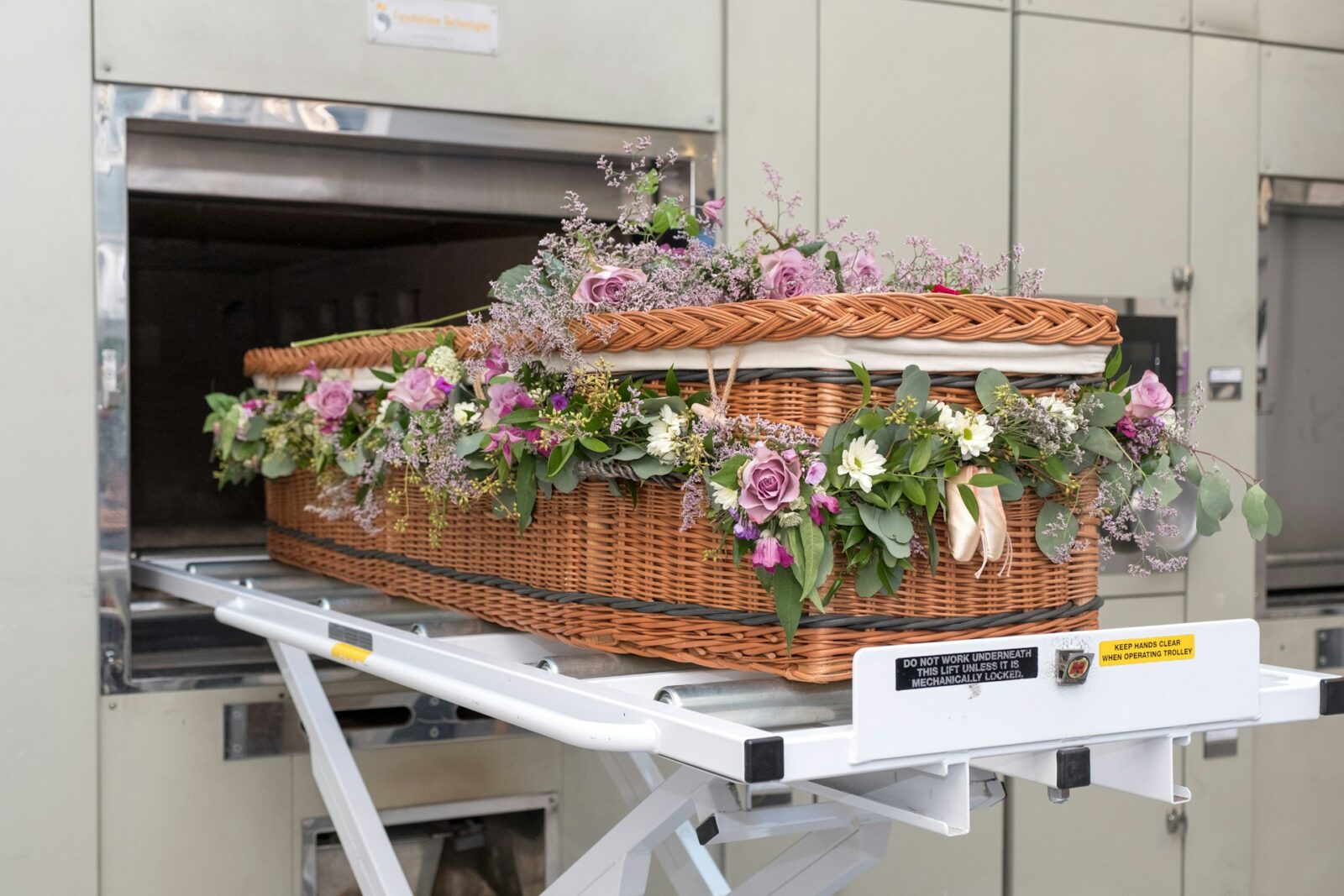
After a UK cremation, what remains and is returned to the family is the cremated remains – bone mineral processed into a fine pale ash, typically 2 to 4 kg, sealed in a labelled temporary container. Anything that does not burn at cremation temperatures, including surgical implants, dental gold, coffin fittings and other metal, is separated by magnet after the cremation. In most UK crematoria these metals are recycled, very often for charity, unless the family specifically asks for an item back. The body itself – all soft tissue, the coffin material, and the organic content of the bones – is consumed by the heat and leaves the chamber as gas and vapour, treated by the secondary chamber and filtration systems.
For most families, the cremation itself is something they understand only in outline. What comes home with them after it is finished is more concrete: a container, a certificate, a quiet handover from the funeral director. This guide explains, in plain and respectful terms, exactly what physically remains after a cremation, what is returned, what is not, and what the family decides about each.
For the cremation process itself, see our guides on how cremation works and on what happens to the body during cremation.
What is left at the end of the cremation
Inside the cremator at the end of the burn, what remains is far less than most people imagine. The intense heat of the chamber – 800 to 1,000°C for around two hours – reduces almost everything to gas and vapour.
What does not remain:
- Soft tissue of the body – all consumed by the heat.
- The coffin – almost entirely consumed; only some fittings survive.
- The organic part of bone (collagen) – burns off during the process.
- Most clothing and any organic items placed in the coffin.
What does remain:
- The mineral framework of the bones, calcined and brittle.
- Metal from medical implants – hip replacements, surgical pins, plates, screws.
- Gold, silver and other precious metals from dental work or jewellery.
- Coffin fittings – hinges, nails, handle attachments.
For an explanation of why bones in particular do not burn away at cremation temperatures, see our companion article on whether cremation burns the bones.
From bone fragments to the ashes the family receives
The bones that remain at the end of the burn are not the fine, uniform powder families later receive. They are dry, calcined fragments. Before the ashes are sealed for return, the crematorium carries out two further steps.
- Metal removal. Once the chamber has cooled, a powerful magnet is passed over the bone fragments to extract any remaining metal. This separates surgical implants, coffin fittings and precious metals from the bone, ready for the next stage.
- Cremulation. The cooled bone fragments are placed into a machine called a cremulator, which uses steel balls or blades to reduce them to a fine, uniform powder. This is the material families recognise as cremation ashes.
For the chemistry of the final ash and what it actually looks and feels like, see our guide to what cremation ashes are.
Key takeaway: The ashes a family receives are bone mineral – the only part of the body that survives cremation – processed mechanically into a fine, pale powder. Everything else has either left as vapour or been separated from the remains as metal.
What happens to medical implants
Many people in later life have some kind of medical implant – hip and knee replacements, plates and screws from old fractures, pacemakers, cochlear implants. Each is handled differently before, during and after the cremation.
Removed before cremation
Battery-powered devices must be removed before the body enters the cremator, because they can explode at high temperatures and damage the chamber. The list includes:
- Pacemakers
- Implantable defibrillators (ICDs)
- Cochlear implants
- Implantable drug-delivery devices
- Certain neurostimulators
Removal is carried out by a qualified technician or embalmer, through a small incision. The procedure is straightforward, dignified and forms part of the funeral director’s preparation of the body.
Left in place during cremation
Non-explosive implants stay in place. The list includes:
- Hip and knee replacements
- Surgical plates, screws, pins and wires
- Prosthetic limbs (sometimes left, sometimes removed by family preference)
- Spinal rods and fixation devices
These items survive the heat of the cremation chamber intact, though they may be discoloured. After the cremation, they are separated from the bone fragments by the magnet stage described above.
What happens to them after the cremation
The recovered metal is collected separately. In almost every UK crematorium it is sent for recycling, and the great majority of crematoria participate in schemes that direct the proceeds to charity – often local hospices, bereavement charities or air ambulance services.
Families are not normally asked to make a decision about this; recycling for charity is the default. If a family has a particular wish – for example, to retain a hip replacement that meant something to the person – they can ask the funeral director in advance and the crematorium will accommodate the request.
Did you know? The Institute of Cemetery and Crematorium Management (ICCM) runs a national Recycling of Metals Scheme in the UK, which has distributed many millions of pounds to bereavement and end-of-life charities since it began. The metal recovered from cremations is a quiet, lasting contribution to the wider good.
What happens to dental work
Dental work raises its own set of questions, and the answers are reassuring.
Tooth enamel
Tooth enamel is mostly mineral, like bone, and survives the cremation chamber. Teeth often detach from the jaw during the burn but are recovered with the bone fragments and processed in the cremulator alongside them.
Amalgam fillings
Traditional mercury amalgam fillings vaporise at cremation temperatures. The mercury they contain is one of the main environmental emissions from cremation, which is why modern UK crematoria are required to fit mercury filtration systems to comply with DEFRA regulations. The mercury is captured before it can escape the chimney.
Gold crowns and gold dental work
Gold has a melting point below cremation temperatures and tends to melt and pool during the burn. It is recovered with the bone fragments at the magnet stage. Gold dental work is treated in the same way as other metals – separated, weighed and either recycled for charity (default) or returned to the family on request, if the request was made in advance.
Good to know: Recovered gold from dental work is usually distorted and discoloured by the heat. Families who ask for it back receive the metal itself, not an intact crown or bridge. If the gold has personal significance, this is worth knowing before the cremation.
Personal items placed in the coffin
Many families place a small personal item or two in the coffin before the funeral – a letter, a photograph, a soft toy, a small piece of jewellery, a flower. Anyone considering this should know what happens to each kind of item.
- Paper, fabric, wood, plant material – consumed by the heat, alongside the coffin itself.
- Jewellery (gold, silver, platinum) – survives the heat, is distorted by it, and is recovered with the metals. Treated as for dental gold.
- Precious stones – some (diamonds) may survive, but most are damaged or shattered by the temperatures involved. Sentimental gemstones should be kept by the family.
- Glass – usually melts and re-solidifies into small fragments; not normally returned.
The widely accepted advice across the UK funeral industry is to remove valuable or sentimentally precious jewellery before the cremation. The cremation is final, and recovered items rarely come back in usable form. If something genuinely matters, it is far better to keep it than to send it with the coffin.
The coffin itself
By UK law, the body enters the cremator inside a sealed coffin, and the coffin is part of the cremation. Most of it is consumed during the burn – the wood, cardboard or willow body of the coffin serves as fuel for the early stage. What remains afterwards is a small amount of metal: nails, hinges, handle attachments, and any decorative fittings.
This metal is recovered with the magnet alongside any from the body, and either recycled or returned by request. Modern eco-friendly coffins (cardboard, willow, bamboo) leave very little metal behind at all.
The paperwork that comes back
Alongside the ashes, the crematorium provides documentation. The exact set varies slightly between facilities, but in the UK it usually includes:
- A Certificate of Cremation, formally confirming the cremation took place. This document may be needed for the burial or interment of ashes, for transport, or for some memorial arrangements.
- The cremation reference number, which links the ashes to the crematorium’s register.
- A short letter or note confirming the date of cremation and any practical instructions.
The funeral director typically handles the paperwork on the family’s behalf and passes the certificate on with the ashes. Keep the certificate safe – it is the document you will refer back to if you later decide to bury, transport or scatter the ashes in a formal setting.
How and when the family receives everything
The journey from the cremation to the family’s hands is short and clearly tracked.
- The cremation is completed. The bone fragments cool, the metal is separated, and the ashes are processed in the cremulator.
- The ashes are sealed in a temporary container. This is usually a tamper-evident plastic urn or a sturdy cardboard box, clearly labelled with the person’s name and the cremation reference number.
- The container is held at the crematorium. Most crematoria release the ashes within 48 to 72 hours of the cremation, though longer holding is available at no extra cost if the family is not yet ready.
- The funeral director collects or the family collects. In most UK cases the funeral director collects the ashes on the family’s behalf. They are then handed over at the funeral director’s premises, by quiet appointment, often with a moment of pause and a brief word of explanation.
- The family decides what comes next. The temporary container is for transport; the long-term home is usually a chosen urn for ashes. Transfer can be done at home or by the funeral director.
There is no time limit on collecting the ashes, and no requirement to make any decision quickly. Crematoria are accustomed to families taking time – some collect the ashes the same week, some take months.
Key takeaway: What comes back to the family is the ashes themselves, the temporary container, a Certificate of Cremation and the cremation reference number. Anything not consumed by the heat – metal implants, dental gold, coffin fittings – has been separated and is, by default, recycled for charity unless the family asked otherwise in advance.
Frequently asked questions
Will I receive everything that was in the coffin?
Not necessarily. Organic items are consumed by the heat. Metal jewellery and dental work survive but are usually distorted and are recycled by default unless the family requested the item back in advance. Ask your funeral director before the cremation if there is anything specific you wish to keep.
Can I get a wedding ring back?
If the ring was on the body or in the coffin during cremation, it will have survived the heat but will be distorted and unlikely to be wearable. To preserve a ring in its original form, remove it before the funeral. If you wish to send it with the person, accept that what is recovered will not be the ring as you remember it.
Are hip replacements really recycled?
Yes, in the vast majority of UK crematoria. Titanium, cobalt, chrome and other implant metals are sorted, melted down and recycled. The proceeds go to bereavement and end-of-life charities through the ICCM’s national scheme. Families do not need to do anything; this is the default.
What if my loved one had a pacemaker that wasn’t removed?
A pacemaker should always be removed before cremation. If for any reason this did not happen, contact your funeral director immediately. Crematoria check for implants as part of their own safety protocols, and the cremation will not proceed until the device has been dealt with safely.
What documents do I need to keep?
The Certificate of Cremation is the key document. Keep it with the death certificate and any other estate paperwork. You will need it if you later choose to bury or inter the ashes at a cemetery, or to transport them internationally.
Can the family witness the recovery of metals or the cremulation?
Most UK crematoria do not offer this as a standard option, though some accommodate specific requests in advance. If this matters to you, ask your funeral director, who will speak to the crematorium manager.
A quiet summary
What remains after a cremation is far less than most families expect, and what is returned is the only part that lasts: the mineral content of the bones, in the form of a fine, pale ash. Everything else – the soft tissue of the body, the coffin, the organic content of the bones – has left the chamber as gas and vapour, dealt with by the secondary chamber and filtration. Anything that did not burn but was not part of the person – implants, dental gold, coffin fittings – has been separated, weighed and, in the great majority of cases, quietly recycled for charity.
What the family receives, then, is the ashes themselves, a sealed temporary container, a Certificate of Cremation, and the freedom to decide what comes next. For the broader picture of cremation in the UK, including the choices that follow, see our complete guide to cremation.