
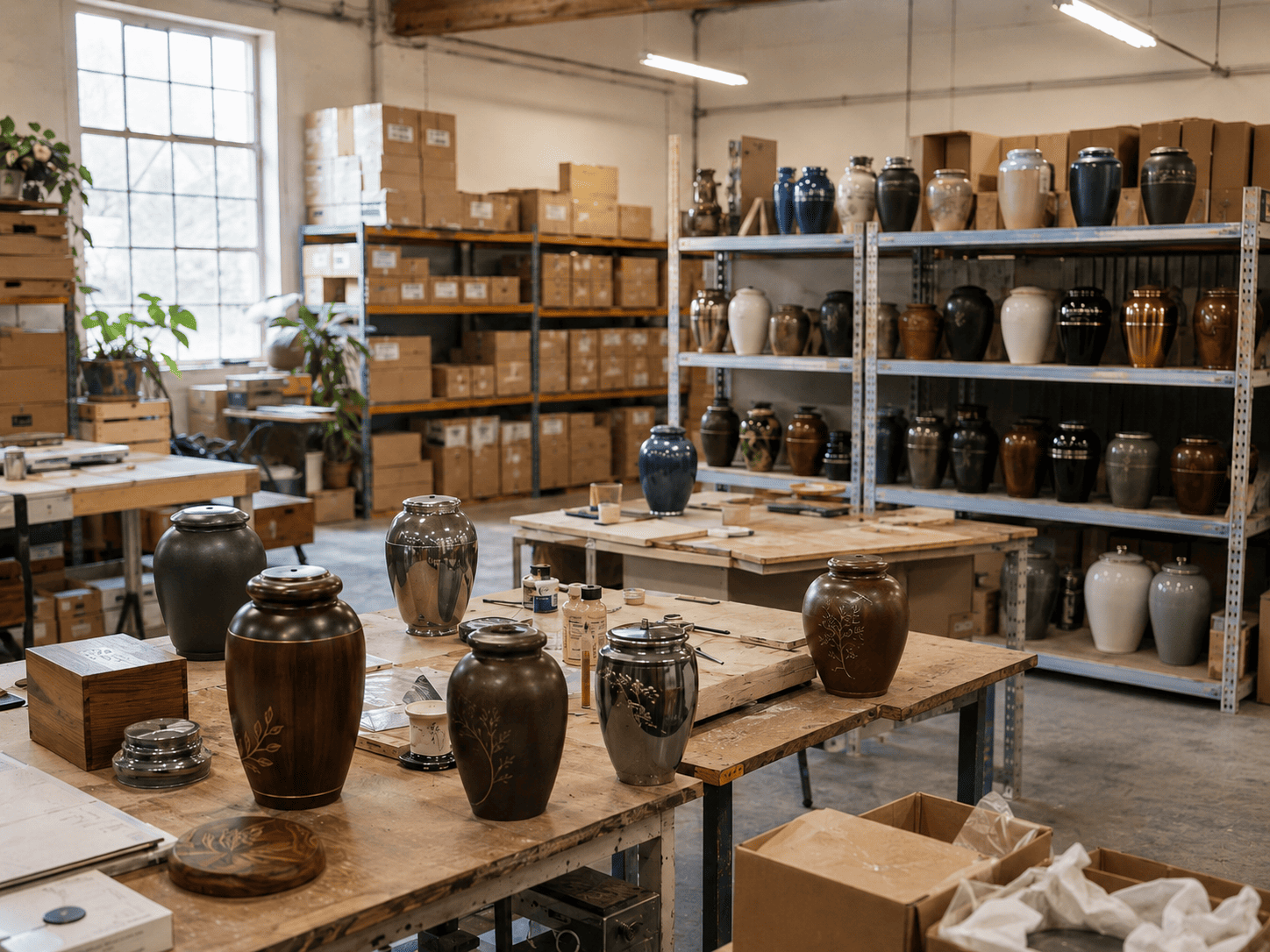
To choose a cremation urn, start with its purpose – whether you will keep the ashes at home, bury them, scatter them or share them between family. Then match the capacity to the person, using the rule of roughly 1 cubic inch (about 16 ml) per 1 lb (about 0.45 kg) of body weight. A standard adult urn holds around 3.3 litres (200 cubic inches), which suits most adults up to about 90 kg (200 lb). Finally, choose a material, finish and personalisation that reflect the individuality of your loved one.
Choosing a cremation urn is one of the most personal decisions a family makes after a loss. There is no single correct answer, only the one that feels right for you and honours the person you are remembering. The choice can feel overwhelming at first, simply because most of us are unfamiliar with urns until the moment we need one.
This guide is written for British families and walks through every consideration that matters: the purpose of the urn, the capacity you need, the materials and finishes available, the options for personalisation, and the practical points around keeping, burying or scattering ashes in the UK. Taken step by step, the decision becomes far clearer.
Why the right urn matters
An urn is far more than a vessel. It becomes a focal point for memory, a place where grief can settle, and often an object that families keep for generations. Whether it sits on a mantelpiece, rests in a garden of remembrance or is buried in a family plot, the urn carries meaning long after the funeral itself has passed.
Because of this lasting significance, it is worth taking time over the choice. An urn that genuinely reflects a person’s character – their tastes, their faith, their interests, or simply their quiet dignity – tends to bring far more comfort than one chosen quickly under pressure.
Start with one question: what is the urn for?
Before looking at materials or designs, decide what the urn will be used for. This single question shapes almost every other choice, because the most suitable urn for keeping ashes at home is not always the most suitable one for burial or scattering.
Keeping the ashes at home
If the urn will remain on display, appearance and durability matter most. Families often choose a piece that complements their home and feels like a fitting tribute, in materials such as wood, ceramic, stone or metal. A display urn is usually a full-size adult urn with a secure closure.
Burying the urn
If the urn will be buried, in a cemetery plot or a dedicated urn garden, durability and the burial regulations of the site become important. Some cemeteries accept any urn, while others require a biodegradable urn or a specific size for an urn plot. It is always wise to confirm the requirements with the cemetery before purchasing.
Scattering the ashes
If you intend to scatter the ashes, you may prefer a simpler scattering urn or a biodegradable urn designed to release the ashes gently. Some families keep a small keepsake urn back before scattering, so that a token portion of the ashes can remain with them.
Sharing the ashes between family members
When several relatives wish to keep a part of the ashes, a set of smaller keepsake urns allows each person to hold a portion. These are sometimes chosen alongside a main urn, or instead of one where no single home is the obvious resting place.
Key takeaway: Decide the purpose first. Display, burial, scattering and sharing each call for a different type of urn, so settling this question early narrows the choice considerably.
Getting the size right: capacity explained
Capacity is the single most practical consideration, and the one families most often worry about getting wrong. Fortunately, there is a reliable rule of thumb that makes it straightforward.
The simple rule of thumb
The volume of cremated remains relates closely to body size before cremation. The widely used guide is to allow approximately 1 cubic inch of urn capacity (about 16 ml) for every 1 lb of body weight (about 0.45 kg). So a person who weighed around 200 lb (90 kg) will need an urn of roughly 200 cubic inches, which is about 3.3 litres. This is exactly why a standard adult urn is sized at around 200 cubic inches.
Capacity by urn type
Different urn types are made to different capacities. The table below shows the usual ranges so you can see at a glance which category fits your needs.
| Urn type | Approximate capacity | Typically suitable for |
|---|---|---|
| Keepsake / token urn | Around 50 – 80 ml (3 – 5 cubic inches) | A small, shared portion of ashes |
| Child or infant urn | Varies; chosen to the individual | A child or infant |
| Standard adult urn | Around 3.3 litres (200 cubic inches) | An adult up to about 90 kg (200 lb) |
| Large or oversized urn | Around 4 litres and above (250+ cubic inches) | A larger adult, above about 90 kg |
| Companion / double urn | Around 5.5 litres and above (350+ cubic inches) | Two adults kept together |
A quick guide by body weight
If you know roughly how much the person weighed, this table gives a direct steer on the urn size to look for.
| Body weight before cremation | Approximate ash volume | Recommended urn size |
|---|---|---|
| Up to 90 kg (200 lb) | Up to about 3.3 litres (200 cubic inches) | Standard adult urn |
| 90 – 115 kg (200 – 250 lb) | About 3.3 – 4.1 litres | Large adult urn |
| Over 115 kg (250 lb) | Over about 4.1 litres | Oversized urn |
Good to know: The rule of thumb is a guide, not an exact measurement. The actual volume of ashes can vary with bone density and other individual factors, so where a person is close to a size boundary it is sensible to choose the slightly larger urn. An urn never needs to be filled completely.
Choosing a material and finish
Once purpose and size are settled, the material is where personal taste truly comes in. Each material has its own character, and the right one often simply feels correct for the person being remembered. The table below summarises the most common choices.
| Material | Character and best for | Points to consider |
|---|---|---|
| Wood | Warm and natural; well suited to display at home | Grain makes each piece individual; keep out of damp conditions |
| Ceramic | Elegant and artistic; takes colour and glaze beautifully | Handle with care as it can break if dropped |
| Metal | Durable and timeless; suits both display and burial | Polished surfaces may need occasional gentle care |
| Stone | Solid and enduring; a strong, grounded presence | Heavier than other materials, which some families prefer |
| Glass | Luminous and contemporary; striking on display | Best kept where it will not be knocked |
| Biodegradable | Designed for burial or scattering; returns naturally to the earth | Intended for one-time use rather than long-term display |
The finish matters as much as the material itself. A matt finish feels quiet and understated, while a polished or glazed surface catches the light and draws the eye. Neither is better; the choice is simply about which feels more in keeping with the person.
Personalising a cremation urn
Personalisation is what turns an urn from an object into a tribute. It allows the urn to speak to the individuality of your loved one, and many families find this part of the process quietly comforting.
Common ways to personalise an urn include the following.
- An engraved name, with dates of birth and passing
- A short inscription, a line of verse or a few meaningful words
- A motif that reflects a faith, an interest or a passion
- A chosen colour or finish that held significance
- A memorial plaque fitted to the urn or its base
When considering an inscription, it is worth thinking ahead about how the urn will be displayed, since the position of engraving can affect how the wording is best read. If in doubt, a simple name and dates is always a dignified and timeless choice.
Urns for particular needs
Some situations call for a specific type of urn. Recognising which applies to you helps avoid a choice that does not quite fit.
Companion urns
A companion, or double, urn holds the ashes of two people together, often a couple who wished to remain side by side. These urns are larger, typically 5.5 litres and above, and may have a single chamber or two separate compartments.
Keepsake urns
Keepsake urns are small vessels that hold a token portion of the ashes. They allow several family members each to keep a part of their loved one, or to retain a little when the main portion is scattered or buried.
Child and infant urns
Urns for a child or infant are made in smaller and gentler forms. Capacity here is always chosen to the individual rather than by a standard figure, and the emphasis falls on tenderness and care in the design.
Pet urns
Many families also wish to honour a beloved pet. Pet urns follow the same principles of capacity and material, sized to the animal, and can be just as thoughtfully personalised as an urn for a person.
Keeping, burying and scattering ashes: the UK position
Once you have chosen an urn, it helps to understand what you may and may not do with the ashes in the UK. The position is generally permissive, but a few practical points are worth knowing.
- Keeping ashes at home is entirely lawful, and many families do exactly this for as long as they wish.
- To scatter ashes on private land, seek the landowner’s permission first. For public parks and beauty spots, check with the relevant authority or landowner.
- To scatter on water, the Environment Agency advises choosing a quiet spot away from buildings and marinas, ideally well away from any point where water is taken for drinking, and removing any non-biodegradable items beforehand.
- For burial in a cemetery or urn garden, confirm the site’s own rules on urn type and size in advance.
Did you know? Cremation is now by far the most common funeral choice in the UK, accounting for around four in five funerals. With so many families holding ashes, the urn has become a meaningful and lasting part of remembrance for the great majority.
This is general guidance rather than legal advice. If you have any doubt about a specific location, it is always best to contact the Environment Agency, your local authority or the landowner directly.
A final checklist before you choose
Bringing it all together, run through these questions before you decide. If you can answer each one, you can choose with confidence.
- What is the urn for – display, burial, scattering or sharing?
- What capacity do you need, based on the person’s size?
- Which material and finish feel most fitting?
- How would you like to personalise it?
- Are there any site rules to confirm, if the urn is to be buried?
- Does the design genuinely reflect the individuality of your loved one?
Key takeaway: Purpose first, capacity second, then material, finish and personalisation. Work through the decision in that order and the right urn will become clear, allowing you to choose something that brings lasting comfort.
There is no rush to this decision, and there is no wrong answer made with love. The most fitting urn is simply the one that feels true to the person you are remembering – a quiet, enduring tribute to a life that mattered.